
The highly acclaimed minimalist factory game, Shapez, is back with its successor, Shapez 2, ushering players into a whole new dimension to construct vast and intricate 3D factories in the vacuum of space. The core concept revolves around extracting raw geometric shapes from floating asteroids, feeding them into complex, player-designed production lines for processing, shaping, and coloring, ultimately delivering them to a mysterious “giant Vortex.” The most significant evolution in this installment is the leap from a 2D plane to a 3D environment, offering unprecedented depth and freedom in factory design.
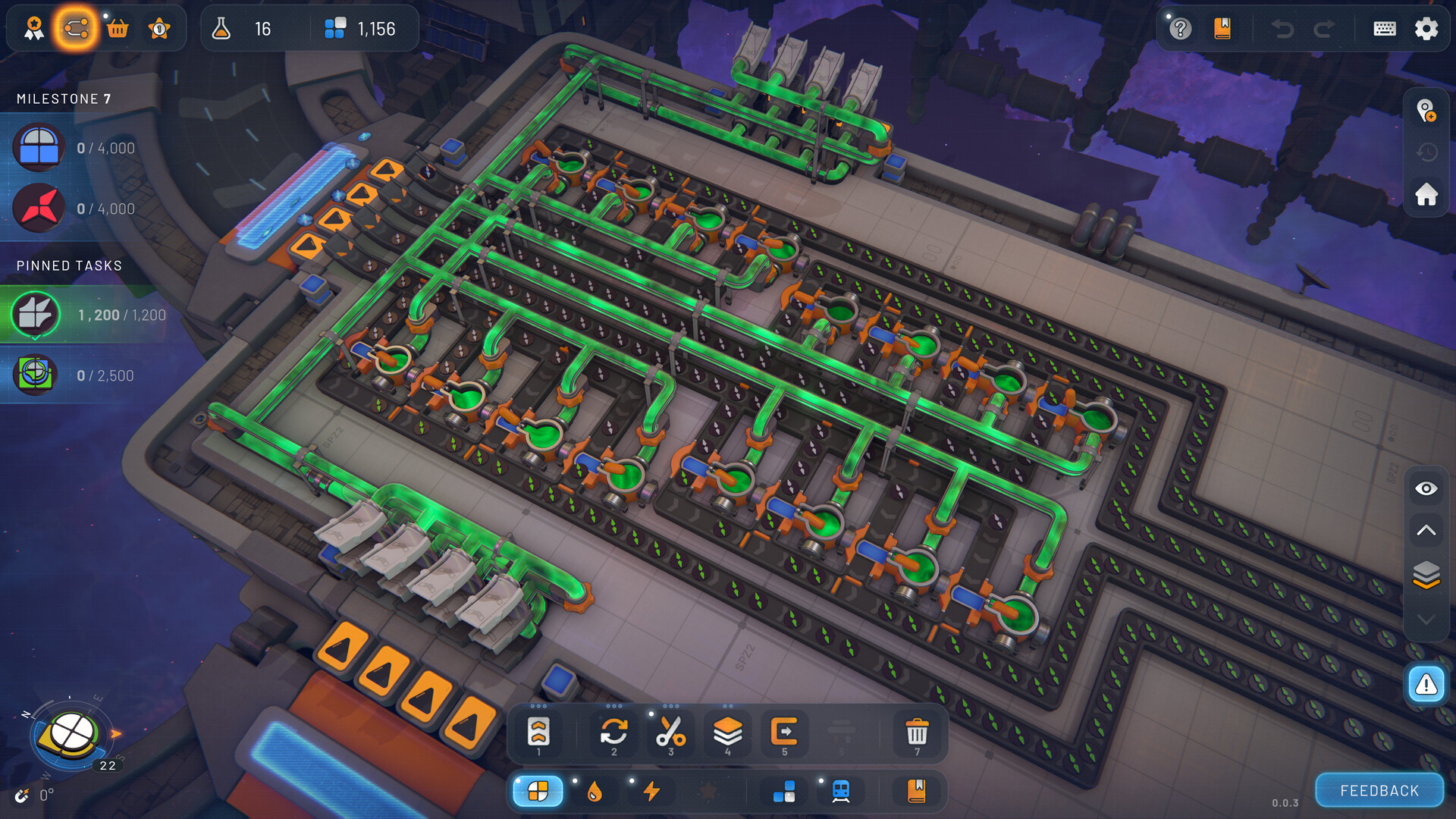
At its heart, Shapez 2 is a top-down factory-building and automation game infused with deep strategic elements. Its unique charm lies in the artful combination of satisfying logistical puzzles and unbridled creative construction. This transition is more than just a visual upgrade; it represents a fundamental revolution in gameplay depth. The success of its predecessor undoubtedly fueled a player desire for more complex mechanics, and the inherent limitations of a 2D plane for factory design are addressed in Shapez 2 by introducing verticality, allowing for more compact and sophisticated automation systems. The development team undertook a “complete rewrite with a new engine” to support this grand vision and ensure the smooth operation of “mega-factories.” While the core of the game is mechanical operation, the “giant Vortex” provides a subtle narrative drive and a clear ultimate production goal for this sandbox world. Player construction is no longer just for its own sake but to satisfy the demands of this cosmic entity, a design that provides strong intrinsic motivation for continuous expansion and optimization of production lines, as more complex shape requirements are often tied to the Vortex’s progression.

The Art of Abstract Industrialization: Core Gameplay Mechanics
The gameplay loop of Shapez 2 begins with mining raw shapes from asteroids floating in space. These shapes are not mere resources but “building blocks” for more complex structures. They consist of multiple layers, each containing several “parts” (four quadrants in regular scenarios, six in hexagonal mode), with each part having a specific “type” (e.g., circle, square, star, rhombus, pin, crystal) and can be colored. Shapes can have multiple layers, typically 1 to 4 in most game modes, and up to 5 in “Insane” mode. The game offers a variety of colors, including red, green, blue, cyan, magenta, yellow, white, and uncolored, each with its corresponding code.
The process of transforming shapes is a precise art, requiring players to utilize a series of tools:
- Cutting: Use the “Cutter” and “Half Destroyer” to break shapes into smaller components or remove unwanted parts.
- Rotating: Employ “Rotators” of different angles (e.g., 90 degrees clockwise, 90 degrees counter-clockwise, 180 degrees) to adjust the orientation of shapes or their parts.
- Stacking: The “Stacker” not only stacks complete layers but, crucially, can merge partial shapes within a single layer if the target layer has empty space—for example, two opposing half-circles can combine to form a full circular layer. This process also considers the in-game “shape gravity rules” (meaning parts need support or they might fall or cause instability, affecting processing) and the fact that crystals shatter when dropped.
- Painting: Use the “Painter” to color shapes with different fluid colors.
- Combining/Assembling within a Layer: There isn’t a single “Assembler” building for complex single-layer shape construction. Instead, players must cleverly use cutters, rotators, the “Swapper” (which can exchange halves of two shapes), or stack partial shapes into the empty quadrants of another. Imagine first cutting a full circle in half, rotating one half, and then using the stacker’s properties to recombine these two halves on the same layer into a special crescent shape, rather than stacking them into two layers. This is where player ingenuity and engineering skills are truly tested.
- Pin Pushing: The “Pin Pusher” is used to add pins underneath shapes, crucial for certain specific constructions, while also adhering to layer limit rules.

The game’s depth doesn’t come from a vast array of complex, functionally diverse buildings, but from how these simple tools—cutting, rotating, stacking, painting, and swapping—can be combined in countless ways to process abstract geometric shapes. Shapes have clear attributes (parts, layers, colors), and tools perform basic transformations. The mastery displayed by players in constructing “Make Anything Machines” (MAMs) lies in orchestrating these simple operations in incredibly complex sequences to produce highly specific shapes. The deliberate omission of a dedicated “assembler” for intra-layer part assembly forces players to creatively utilize stackers for partial shapes or employ swappers, promoting a deep understanding of the system’s underlying logic rather than just placing a “solution” building. This design philosophy encourages true engineering thinking and problem-solving.
Shapez 2 adheres to a “pure factory building” core philosophy, creating a stress-free environment for players: no enemy incursions, inexhaustible resources, no cost for placing buildings, and no frustrating time limits. All focus is on design, optimization, and tackling logistical challenges at the player’s own pace. The game allows players to delete, redesign, and rebuild at will without penalty, offering a convenient undo/redo function (up to 50 steps). This deliberate removal of external pressures (like enemies or resource scarcity) is what sets Shapez 2 apart, redefining “challenge.” While traditional factory games often involve survival or economic pressures, Shapez 2 channels all player energy into the intellectual challenge of design and optimization. This “zen-like atmosphere” or “relaxing, pressure-free gameplay” appeals to players who prefer intrinsic motivation (solving puzzles, creating efficiency) over extrinsic pressures. It allows for fearless experimentation (“easily delete, redesign, and rebuild”), which is crucial for mastering the complex interactions required for advanced automation.
Furthermore, the use of abstract “shapes” instead of concrete items (like “iron plates” or “circuit boards” in other games) as production objects simplifies recipe memorization while retaining combinatorial complexity. Players don’t need to memorize a vast number of specific item recipes but rather learn a universal set of transformation rules applicable to any shape. Complexity then arises from the geometric and layered nature of the shapes themselves, making the core challenge one of spatial and logical reasoning rather than recipe management.
Building Beyond Boundaries: Key Features of Shapez 2
Shapez 2 introduces several innovative features that significantly expand the possibilities and depth of factory construction.
Ascend to New Heights: Multi-Layer 3D Factories
The game allows players to build factories across multiple interconnected layers, meaning designs can be compressed and optimized in a “whole new dimension.” This feature revolutionizes spatial layout thinking compared to traditional 2D factory builders. Multi-layer factories are not just a visual change; they shift the core challenge from 2D route planning to 3D spatial logistics. In 2D, space is the primary constraint, often leading to “spaghetti belts.” The introduction of 3D layers doesn’t eliminate this challenge but adds a new axis for solutions. Players must now consider vertical layouts, how different levels interact, and how to efficiently transfer resources between them (e.g., using belt elevators). This vastly increases the solution space for any given production problem, fostering more creative and compact designs. For players who enjoy optimizing space and efficiency on a more complex level, this is a significant boon. The subsequent “Dimension Update” further enhances this by allowing multi-level platform building for belts, rails, and pipes.
Interstellar Logistics: Space Trains and Advanced Transport
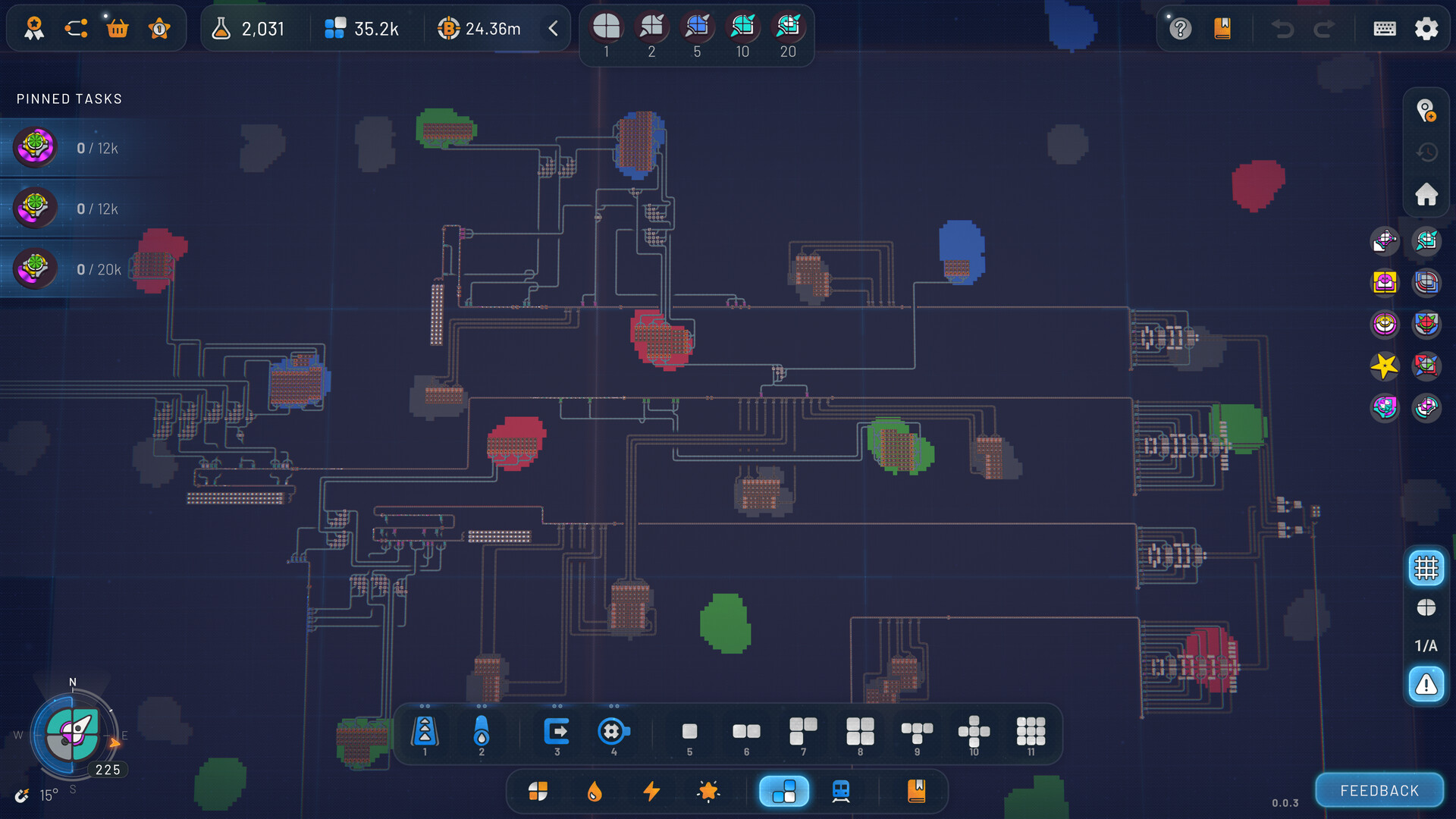
As factories expand, players can utilize a space train system to connect distant outposts and transport resources across a vast cosmic map. The game’s progression allows players to start with single belts and gradually evolve into “massive multi-station space factories connected by space trains.” Trains are not just transport; they are fundamental to enabling large-scale production and encouraging modular design. As factories expand to meet increasingly complex shape demands, local resource patches become insufficient. The train system allows players to tap into distant resources and specialize production on different platforms or “stations.” This naturally promotes modular design—creating self-contained production units that can be easily plugged into the train network. The “Dimension Update” overhauls the train system with updated visuals, smarter stations, configurable unloaders, instant-transfer stations, and new train colors, making large-scale automated logistics more manageable and efficient.
The Flow of Innovation: Fluids and Their Applications
The game introduces different types of liquids (fluids) used for processing shapes, primarily for coloring (using “Painters” and “Mixers”) and crystal generation (“Crystal Generators”). It also provides buildings for fluid transport (“Pipes,” “Pumps,” “Fluid Launchers”) and storage (“Fluid Tanks”). The fluid system introduces a unique layer of logistical and processing challenges that run parallel to, and intersect with, solid shape manipulation. While the primary uses currently center on coloring and crystal generation, the presence of a dedicated fluid system (pipes, pumps, tanks) suggests a complexity beyond simple color application. Players must manage fluid extraction, transport, mixing (via mixers), and application, which presents challenges analogous to shape processing but with different mechanics (e.g., using pipes instead of belts). This adds another dimension to factory design, requiring players to integrate two distinct resource flows. The existence of the “Crystal Generator” further indicates that fluids can be transformed into a special type of shape component, further intertwining the two systems.
Automation Logic: Wires and Complex Control Systems
The “Wires” system brings advanced automation and the possibility of creating complex logical control systems to the game. At its core are several collaborating components: basic “Signal Producers” can output preset logical signals, serving as the starting point for automation commands. “Logic Gates” (such as AND, OR, NOT, XOR, Comparison, and Gate/Transistor) perform Boolean operations on incoming signals, forming the foundation for building complex decision-making and control flows to precisely regulate factory behavior. To interface the wire system with the physical world, “Belt Readers” detect shape information on belts and convert it into wire signals, while “Belt Filters” sort and divert shapes on belts based on received wire signals. Furthermore, “Simulated Buildings” (like simulated rotators, stackers, painters, and the crucial “Shape Analyzer”) don’t directly process physical shapes but operate on their “signal” representations. This allows players to perform complex virtual processing, pathfinding, and decision-making before actual physical processing. The “Shape Analyzer” is particularly important, as it can read the type and color of specific parts of an incoming shape “signal” and output this information as new wire signals for subsequent logical evaluation.
The combination of these tools enables players to construct “Make Anything Machines” (MAMs) capable of automatically producing required shapes. The Wires system elevates Shapez 2 from a purely physical logistics game to the realm of programmable automation and abstract logic. Basic automation involves routing physical items, whereas wires introduce an information layer (signals) that can be manipulated via logic gates and simulated buildings. This allows players to design “smart” factories capable of making decisions, “reading” shape requests (e.g., via a global wire receiver for random operator targets), and dynamically adjusting production. The “Make Anything Machine” is the pinnacle of this concept, essentially requiring players to program a universal shape constructor. Simulated buildings, in turn, permit complex calculations and transformations on shape “data” before committing to physical processes. Players can use simulated buildings like the Shape Analyzer to deconstruct a target shape’s signal, rather than verifying correctness or determining components through physical processing. This information can then drive the logic of the physical factory. This approach, akin to creating a “digital twin” for the shaping process, allows for intricate analysis and decision-making within the wire network, crucial for efficient MAMs.
Unleashing Potential: Research, Progression, and Game Modes
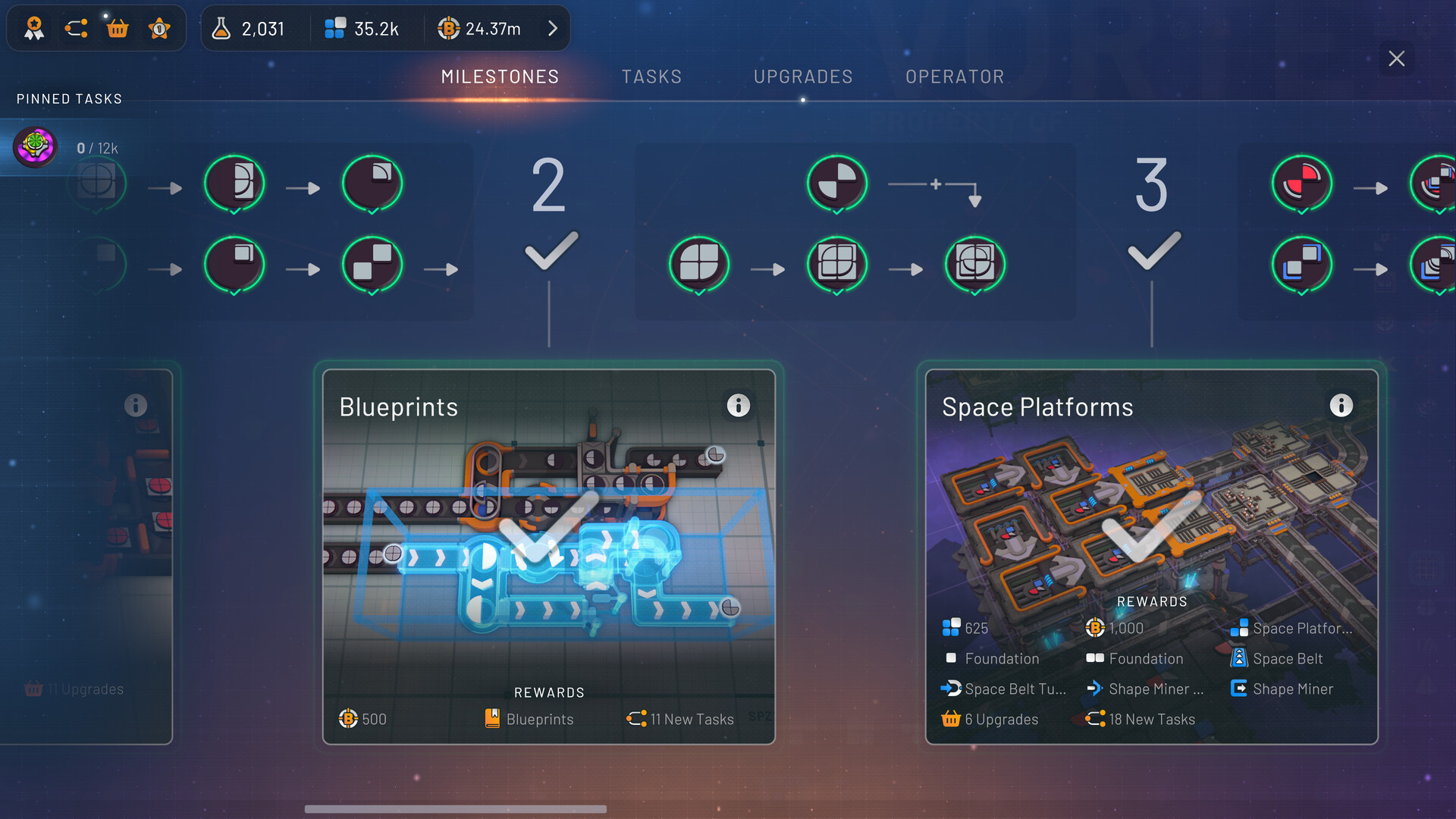
Shapez 2 features a brand-new tech tree through which players unlock new buildings, mechanics, and upgrades. Game progression is primarily driven by completing “Milestones,” “Tasks,” and leveling up the “Operator Level,” all of which reward “Research Points,” “Platform Units,” and “Blueprint Points.”
- Milestones: Serve as major objectives, requiring players to produce specific shapes in large quantities, unlocking new buildings, upgrades, and tasks upon completion. Each game scenario has its unique milestones.
- Tasks: Are typically smaller objectives, sometimes tutorializing, sometimes posing specific challenges, rewarding points upon completion.
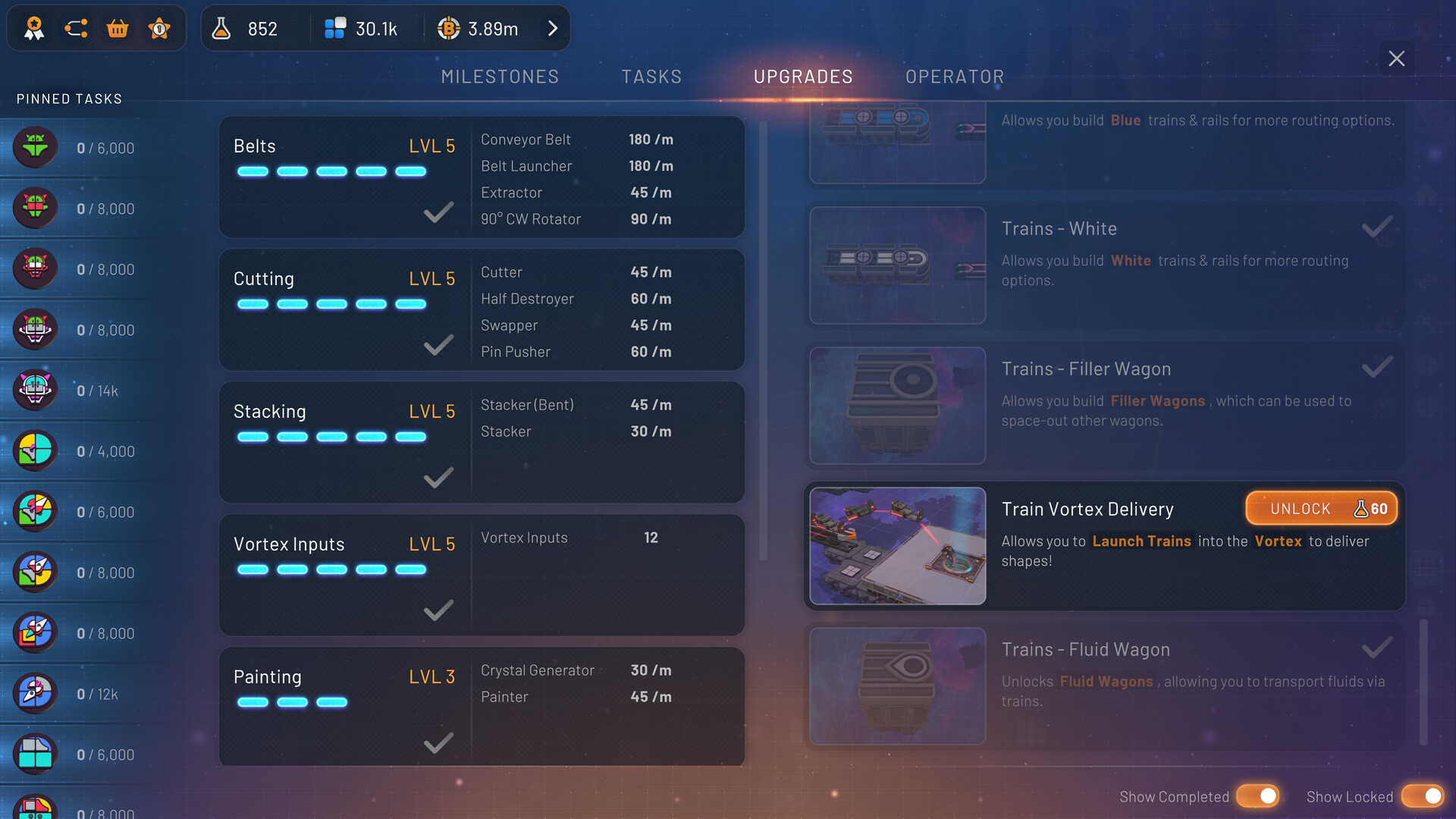
- Upgrades: Purchased with Research Points. Linear upgrades improve speed or capacity (e.g., belt speed, cutting speed, stacking speed, vortex input, painting speed, train speed/capacity, shape multiplier), while unlockable upgrades provide new buildings or features (e.g., cutter, swapper, logic gates, foundations).
- Operator Level: An infinite progression system unlocked after completing all milestones and tasks, requiring players to produce increasingly complex Random Operator Shapes (ROS) for rewards, encouraging continuous factory improvement.
- Knowledge Panel: An in-game guide explaining various mechanics, the research system, milestones, tasks, upgrades, and the operator level.
- Game Modes: Offers four game modes, including a unique “Hexagonal Shapes Mode” which changes the fundamental geometry of shapes (each layer consists of 6 parts instead of the traditional 4). Other modes include Normal, Hard, and Insane, plus a tutorial mode called “Operator Certification.” Players can also customize difficulty settings and game rules (e.g., “No Straight Stackers,” “No Splitters”).
The game’s progression system is not a single path but an interconnected web of milestones, tasks, upgrades, and operator levels, providing both a guided learning curve and open-ended challenges. Different game modes (especially Hexagonal mode) and optional game rules fundamentally alter the core puzzle-solving, offering immense replay value.
Visuals, Blueprints, and Quality of Life
Shapez 2 also receives a comprehensive upgrade in visual presentation and player experience:
- All-New Visuals: The game boasts a stunning, immersive space environment, completely rewritten in a new engine to ensure even massive 3D factories run smoothly.
- Blueprint Library: Players can save, load, export, and share factory designs as blueprints. This enables the design of modular, blueprintable platforms for mass construction (placing hundreds of buildings with a single click). The blueprint system is more than a convenience; it’s a powerful tool for scaling factories and fostering community interaction.
- Animated Open Buildings: Players can clearly see the inner workings of buildings, aiding in debugging and understanding processes.
- Undo/Redo: Supports up to 50 steps, encouraging players to experiment boldly without fear of irreversible mistakes.
These Quality of Life (QoL) features, combined with the game’s “no penalty” design philosophy, demonstrate the developers’ emphasis on player agency and a smooth, enjoyable building experience.
Expanding the Universe: The “Dimension Update” and Ongoing Development
After entering Early Access on August 15, 2024, the development team at tobspr Games hasn’t slowed down. The recently launched “Dimension Update,” the game’s first major free update, brings significant enhancements and expansions. This update has been hailed as “the biggest update yet” and “massively expands the game content.”
Key features of the “Dimension Update” include:
- Multi-Level Platform Building: Allows players to lay belts, rails, and pipes across multiple vertical levels, enabling even more complex and sophisticated 3D factory layouts.
- Train System Overhaul: Includes updated visuals, smarter docking stations, configurable unloaders, instant-transfer stations, and new train colors for better organization and differentiation of train lines.
- Smarter Logistics Tools:
- Faster Space Belts: Throughput has been increased by 400%, with a single belt now capable of carrying four times as many items.
- Overflow Splitters: This new tool allows players to prioritize item flow to one output, with any excess or overflow automatically routed elsewhere, enabling smarter and more flexible resource distribution.
- Variable Range Launchers: The range of belt launchers, fluid launchers, and wire transmitters can now be adjusted, offering greater flexibility in factory design and connectivity.
- Major QoL Enhancements:
- Shape Search: Players can now locate specific shapes on the infinite map, crucial for managing large, complex factories.
- New Platform Layouts: Classic T, L, and Cross layouts return with new variations, providing more options for designing efficient and aesthetically pleasing factory structures.
- UI/UX Improvements: Includes operator previews, a categorized shop for easier navigation, wire insights for better understanding of electrical connections, and clearer throughput displays for monitoring production efficiency.
This substantial free update, released shortly after the game entered Early Access, showcases tobspr Games’ strong post-launch support and their willingness to make significant revisions to core game systems based on their development vision and, likely, player feedback. Features like “Shape Search” and “Faster Space Belts” directly address common pain points in large, complex factories, indicating that the developers are actively engaged with the game and understand the late-game needs of their dedicated player base.
tobspr Games, founded by Tobias Springer and based in Germany, specializes in automation games. Their emphasis on community feedback is also commendable, as stated by a developer on Reddit: “We work closely with the community to determine what features and changes we should add,” a sentiment echoed in the game’s Discord community interactions. Furthermore, the development of Shapez 2 received funding support from the German government. The team’s focus on the automation niche means they have a deep understanding of the genre’s nuances and player expectations, which is reflected in the game’s high-quality experience and overwhelmingly positive reception.
Will Shapez 2 Be Your Next Cosmic Construction Project?
In summary, Shapez 2 presents players with a unique cosmic engineering feast, characterized by its ingenious design, extreme pursuit of logistical mastery, vast creative freedom, and an engrossing automation flow.
Shapez 2 is highly recommended for the following types of players:
- Fans of Factory Automation and Simulation Games: If you love titles like Factorio, Satisfactory, or Dyson Sphere Program and are seeking a unique, abstract new experience, Shapez 2 will be your perfect match.
- Players Who Thrive on Complex Puzzles and Optimization: The game’s constantly emerging logistical challenges and opportunities for efficiency improvement will provide endless mental stimulation.
- Individuals Seeking Creative Expression: If you yearn to freely construct vast and intricate automated systems in a pressure-free sandbox environment, this is your ideal playground.
- Players Who Appreciate the Marriage of Minimalist Aesthetics and Deep Mechanics: The game carries incredibly rich and profound gameplay mechanics within a clean visual style.
Potential Challenges and Considerations
While Shapez 2 captivates a broad audience with its unique charm, there are potential challenges and aspects worth considering while enjoying this cosmic automation extravaganza:
- Learning Curve for Advanced Mechanics: Although the game’s basic tutorial is adequate, as players delve deeper, especially into the Wires system, complex logic control (like building “Make Anything Machines”), and extreme 3D spatial optimization, some players unfamiliar with such deep automation games might face a steep learning curve. Understanding and mastering these advanced mechanics require considerable time and effort for exploration and trial-and-error.
- Performance in Extremely Large Factories: While the development team has optimized the new engine to ensure smooth operation of large factories, in the late game, when factories expand to a truly cosmic scale with massive numbers of buildings, intricate conveyor networks, and high-frequency train scheduling, computers with relatively lower hardware configurations might still encounter performance bottlenecks, experiencing frame drops or stuttering.
- Audience Limitation of Abstract Style: The core of Shapez 2 lies in pure geometric shape processing and abstract logical construction. While this minimalist and abstract style is a unique charm, it might also make players who prefer more concrete products, richer environmental interactions, or stronger narrative-driven experiences feel less engaged or find it difficult to maintain sustained interest.
- Completeness and Balance during Early Access: As the game is currently in Early Access, and despite the development team’s proactive update approach (like the “Dimension Update”), players should understand that the game’s content, features, and numerical balance may not yet have reached their final, polished state. During gameplay, occasional bugs might be encountered, some systems or content may require further refinement and expansion, or future versions might introduce adjustments to game balance.
- Potential for Repetitiveness in Late Game: The late-game “Operator Level” system, while theoretically offering infinite challenges by continuously generating more complex random shape requirements to drive players to optimize and expand their factories, might, for some players seeking new core mechanic breakthroughs or diverse objectives, lead to a sense of repetition or diluted purpose over extended periods of similar “produce-submit” cycles, even if the shapes themselves are ever-changing.
Conclusion: A Cosmic Challenge for Factory-Building Enthusiasts
Shapez 2 is currently in Early Access (since August 15, 2024), and the development team at tobspr Games has shown a commitment to actively listening to community feedback and continuously polishing the game. The core appeal of this title lies in its pure pursuit of the essence of factory building, deliberately stripping away common external pressures like combat, resource scarcity, or complex narratives. This allows players to fully immerse themselves in the joy of designing, optimizing, and expanding automated production lines.
For those tired of the cumbersome survival elements in traditional factory games and yearning to construct their own unique automation empire in a cosmic sandbox that purely tests logical thinking, spatial planning, and creativity, Shapez 2 offers more than just a “100% factory building experience.” It’s an invitation from the vast cosmos to delve into endless design possibilities and challenge the ultimate form of abstract industrialization. So, are you ready to embrace this cosmic challenge, tailor-made for factory-building aficionados, and forge your shape empire?
Early Access Release Date: August 15, 2024
Steam Store Page: https://store.steampowered.com/app/2162800/Shapez_2/



 LaLaWiz Games
Leave a comment